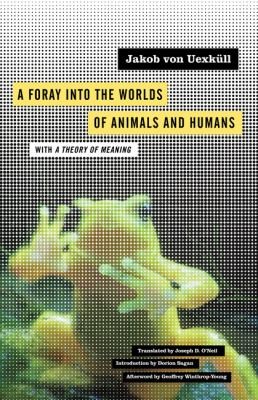
This one isn’t fiction and it isn’t even really adjacent to the shelf I usually pull from, but I keep coming back to it whenever I’m reading anything with an alien or a nonhuman intelligence in it, so it earns its spot here. Uexküll’s whole project is the idea of the umwelt, the notion that a tick or a sea urchin or a dog doesn’t perceive “the world” the way we do but a radically pared down slice of it built entirely around what that creature can act on. The tick example is the one everyone remembers, an animal that can go years sensing basically nothing but butyric acid and warmth, waiting to drop onto a passing mammal, and Uexküll uses it to argue that this narrow, almost absurdly reduced perceptual bubble is not a lesser version of our world but a complete one on its own terms.
I read this originally because a professor assigned it in a course that had nothing to do with fiction, something closer to phenomenology of life, and I went in expecting dry biology and got something closer to philosophy dressed as biology, occasionally verging on genuinely strange. There’s a real pleasure in watching a scientist from the 1930s reach for metaphors that still feel fresh, describing an animal’s world as a soap bubble it carries around itself, sealed off from every other creature’s soap bubble even when they’re standing in the same field. It’s a slim book, you could read the core of it in an afternoon, but I found myself stopping constantly to just sit with an idea before moving on, the same way I do with the good weird philosophy.
If you’ve read anything about Uexküll’s influence on later thinkers, biosemiotics, some of the more interesting corners of animal cognition writing, you already half know this book by reputation without having read it, and I’d say go read the actual thing, it’s shorter and odder and more direct than the secondhand versions of it. It’s not for everyone. It demands you sit still with an idea instead of being carried by plot, same complaint some people have with Always Coming Home honestly, and if that’s not what you’re in the mood for you’ll bounce off it fast. But it rewired something in how I think about every animal I pass on a walk, and that’s not nothing for a ninety year old biology monograph to still be doing.