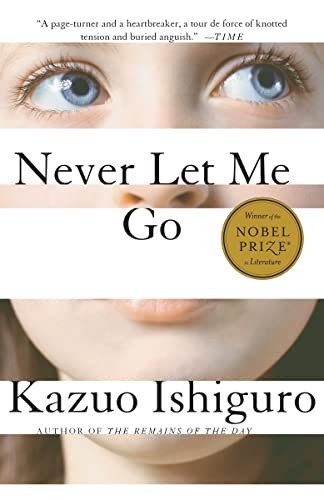
I’m going to try to write about this without spoiling the thing that makes the first hundred pages work, because I think the book genuinely depends on you not knowing exactly what Hailsham is until Ishiguro wants you to know, and I went in mostly blind and I’m glad I did. What I can say is that Kathy, Ruth and Tommy grow up together at an English boarding school that is quietly, insistently not a normal boarding school, and the horror of what they actually are creeps in sideways through Kathy’s flat, careful, almost willfully understated narration rather than through any single dramatic reveal.
The pacing is going to be a real sticking point for some readers and I want to be honest about that instead of pretending it isn’t. Almost nothing happens in the conventional sense, no chase, no confrontation, no third act reversal, just three people slowly, slowly coming to terms with a fate they’ve half known about their entire lives and have been trained not to look at directly. I’ve seen people call it the most action-less science fiction they’ve ever read and I understand the complaint completely even as I disagree that it’s a flaw. The tension here isn’t will-they-escape, it’s how a person metabolizes an unbearable truth when escape was never actually on the table, and Ishiguro trusts that question to carry the whole book without a single twist to prop it up.
Kathy’s voice is the real engine, that specific Ishiguro trick of a narrator who keeps circling back, correcting herself, revising small memories, and you slowly realize the circling itself is the point, she’s protecting herself from the full weight of what she’s telling you at the same pace she’s revealing it to you. By the ending, which I won’t describe, I was doing that thing where you close a book and just sit there for a minute before doing anything else. It’s heartbreaking in a completely unshowy way, and the ethical and moral complications that other readers have noted only really land once the book is over and you start turning it over in your head. I’d put this on the very short list of books that changed how I read everything after it.